

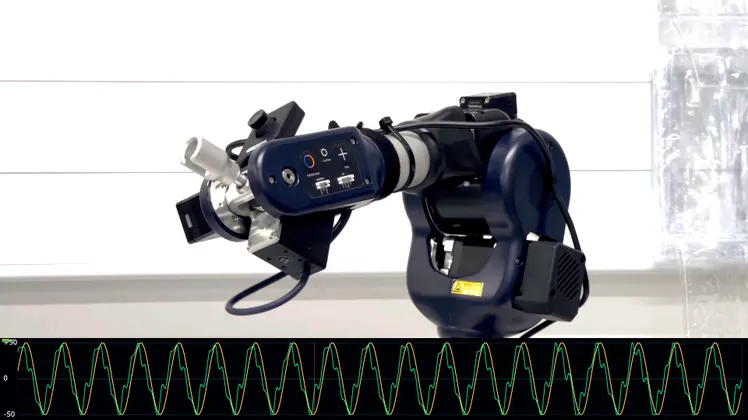
Ned3 Pro Adaptive Controller (No Torque Interface)
/ 2 min read
Table of Contents
Role
Developer - Robotics Control Systems
Project Summary
I built a custom controller for the Ned3 Pro focused on one core problem: running an adaptive control law when the practical motor interface does not provide a direct torque command path.
The result was a working ROS1 controller that executes the control law in torque-like form, then safely bridges it to current-mode actuation on hardware.
Core Challenge
- The control design is expressed in torque-domain form.
- The practical motor interface on Ned3 Pro had to be driven through current-mode commands (Mode 0), not direct torque writes.
- This required a reliable torque-to-current bridge with runtime safety constraints.
What I Built
- A custom
ros_controlplugin:niryo_robot_paper_controller/NeuralAdaptivePidController
- Hardware integration for Ned3 Pro joint control in a private single-joint configuration.
- Real-time command bridge:
- computes adaptive controller output in torque-like form
- maps output into safe current-domain actuation
- sends low-level motor commands through the hardware driver interface
- Runtime interfaces for experiments:
- desired trajectory input
- torque/current override input
- online PID gain update input
- present-current feedback publishing
Safety and Reliability Layer
- Current clamp to hard limits
- Command freshness timeouts
- Explicit operating-mode switching for motors:
- torque off
- set operating mode to current control
- torque on
- Optional online current readback for monitoring
Key Outcomes
- Delivered a deployable adaptive controller on real Ned3 Pro hardware despite the lack of a direct torque command interface.
- Closed the practical gap between torque-law controller design and current-mode motor actuation.
- Built a controllable and testable ROS runtime for controller experiments with safety constraints.
- Verified this controller approach on three primary robot motors.