

TalkingHeadAI - Digital Clone with Personal Context
/ 5 min read
Table of Contents
Role
Developer - AI Systems Architecture and Full-Stack Integration
Project Summary
This project is a real-time conversational talking-head mentor system where users ask questions by voice or text and receive synchronized, lip-synced avatar responses. The platform combines speech-to-text, routing, retrieval, generation, text-to-speech, and avatar streaming in one loop, with persistent memory, bilingual Persian/English handling, mentor-approved answers, and an admin dashboard for transcript ingestion, knowledge-base review, RAG index checks, quick tests, and threshold tuning.
Repository
Project Overview Video
This walkthrough shows the complete TalkingHeadAI experience from the user-facing avatar interface through the mentor dashboard used to manage the knowledge pipeline.
Product Screenshots
Frontend: Conversational Avatar Interface
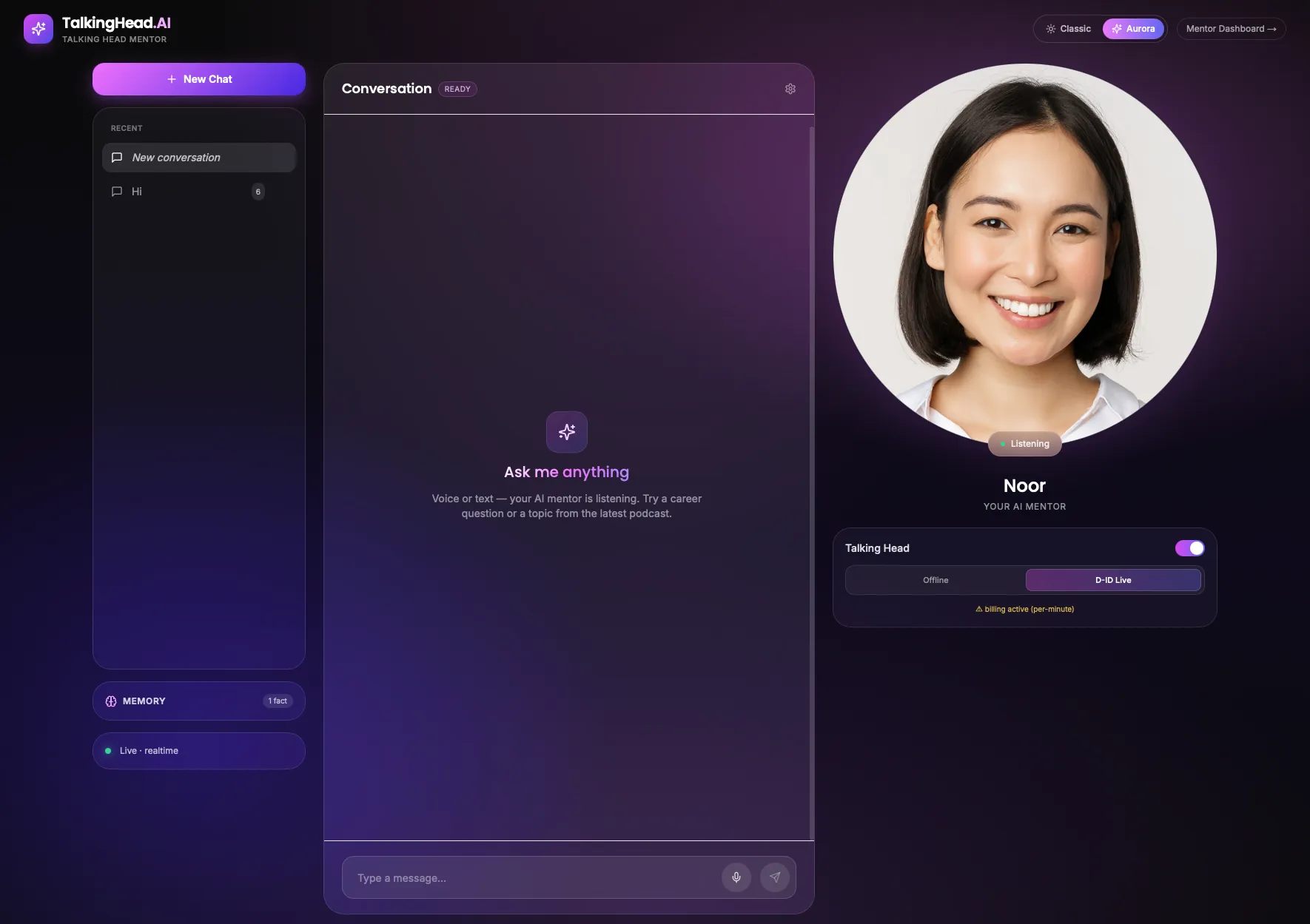
The frontend presents a live conversational workspace with chat history, memory visibility, realtime status, microphone/text input, and a talking-head mentor avatar named Noor. The UI supports voice or text interaction, Persian RTL and English LTR auto-detection, and keeps the avatar state visible, including the D-ID live mode toggle.
Backend/Admin: Mentor Dashboard
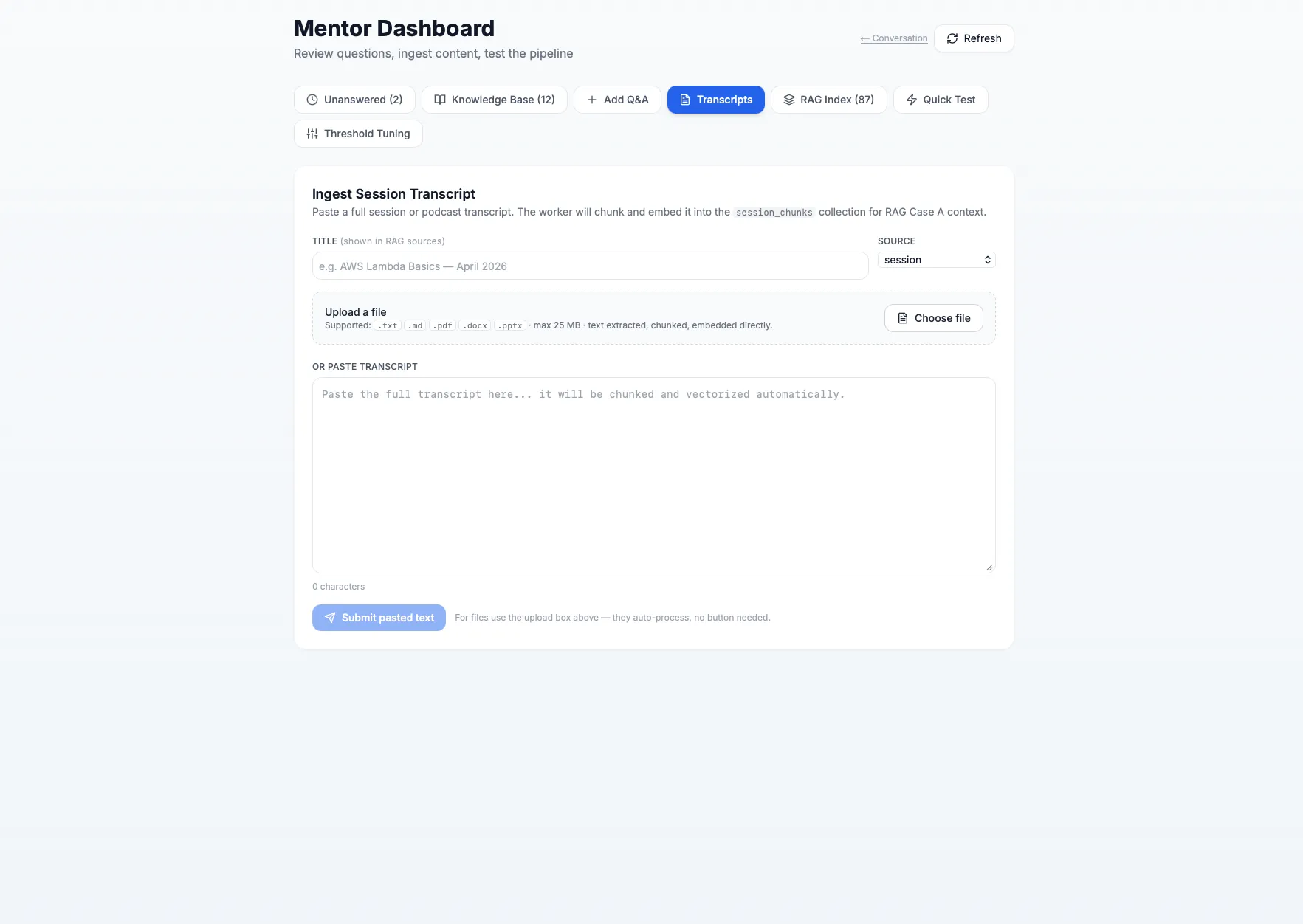
The mentor dashboard is the operational side of the system. It includes unanswered-question review, knowledge-base management, manual Q&A insertion, transcript ingestion, RAG index inspection, quick testing, and threshold tuning. The transcript screen supports pasted content and file upload for .txt, .md, .pdf, .docx, and .pptx files, then chunks and embeds the content into the session_chunks retrieval collection.
Systems Used
- Backend API and orchestration: Python 3.11, FastAPI, SQLAlchemy 2.0 async, Celery
- Frontend client: Next.js 14, React 18, TypeScript, Tailwind CSS, Vazirmatn RTL support
- Mentor dashboard: unanswered queue, knowledge-base review, Q&A creation/edit/delete, transcript ingestion, RAG index inspection, quick tests, and threshold tuning
- Structured data layer: PostgreSQL 16
- Vector retrieval layer: Qdrant
- Cache and queue layer: Redis
- LLM and generation services: Claude Sonnet 4.5, optional Ollama path
- Embeddings: OpenAI text-embedding-3-small (1536 dimensions), with local fallback design
- Speech pipeline: Deepgram (STT) + ElevenLabs/OpenAI (TTS)
- Avatar rendering: D-ID WebRTC streaming, D-ID clip mode, and SadTalker offline fallback path
- Transcript ingestion pipeline: text/file upload, document parsing, chunking, embedding, and
session_chunksindexing - Runtime and local orchestration: Docker Compose
System Diagrams
1) System Architecture Overview
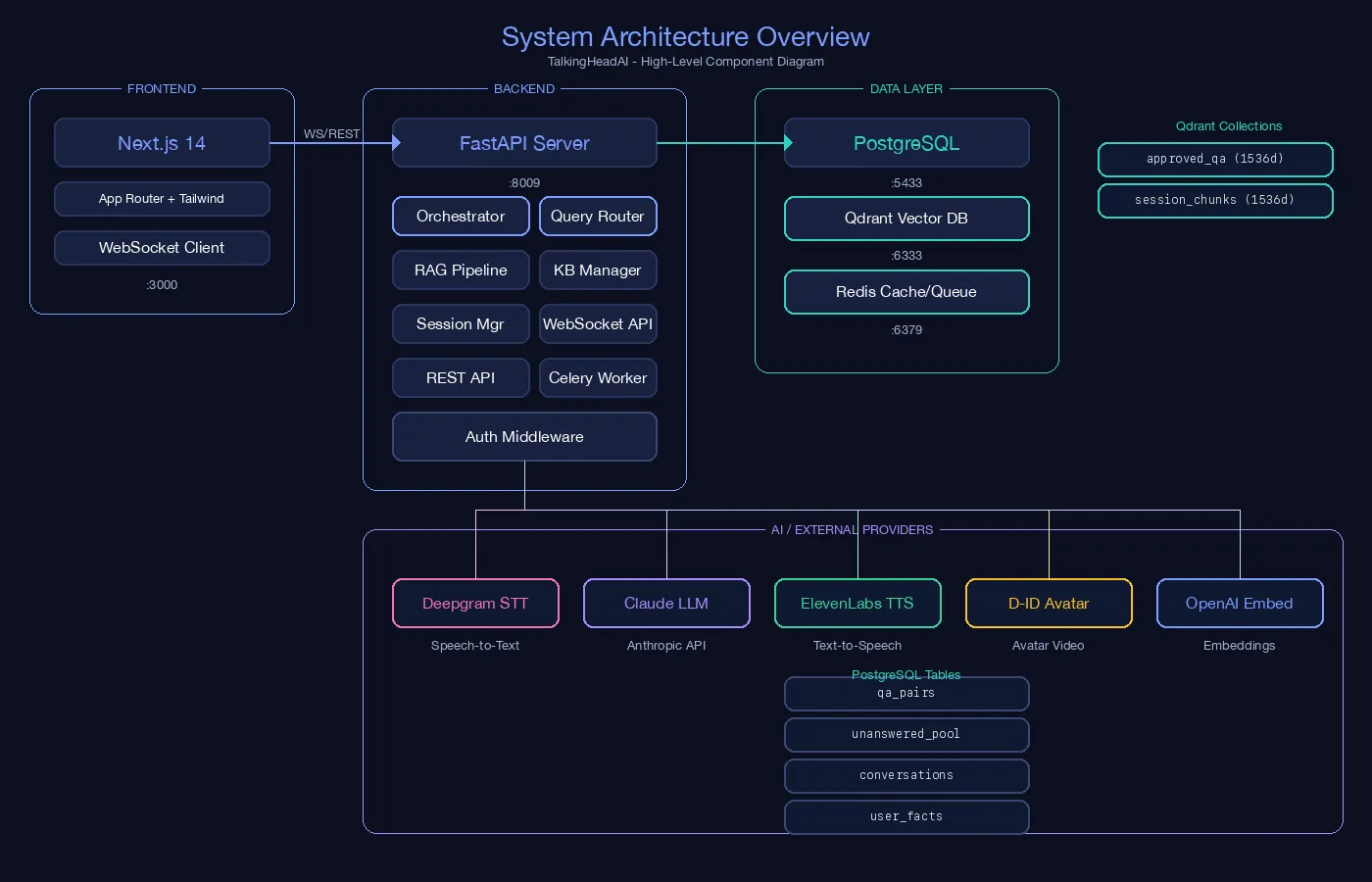
This diagram shows the full component map:
- Frontend layer: Next.js App Router + Tailwind + WebSocket client.
- Backend layer: FastAPI server with orchestrator, query router, RAG pipeline, KB manager, REST and WebSocket APIs, and worker services.
- Data layer: PostgreSQL, Qdrant, and Redis with clear service ports.
- External providers: Deepgram (STT), Claude (LLM), ElevenLabs (TTS), D-ID (avatar), and OpenAI embeddings.
It explains how boundaries are defined between product UI, decision logic, stateful storage, and AI provider integrations.
2) Request Flow: Voice to Avatar Response
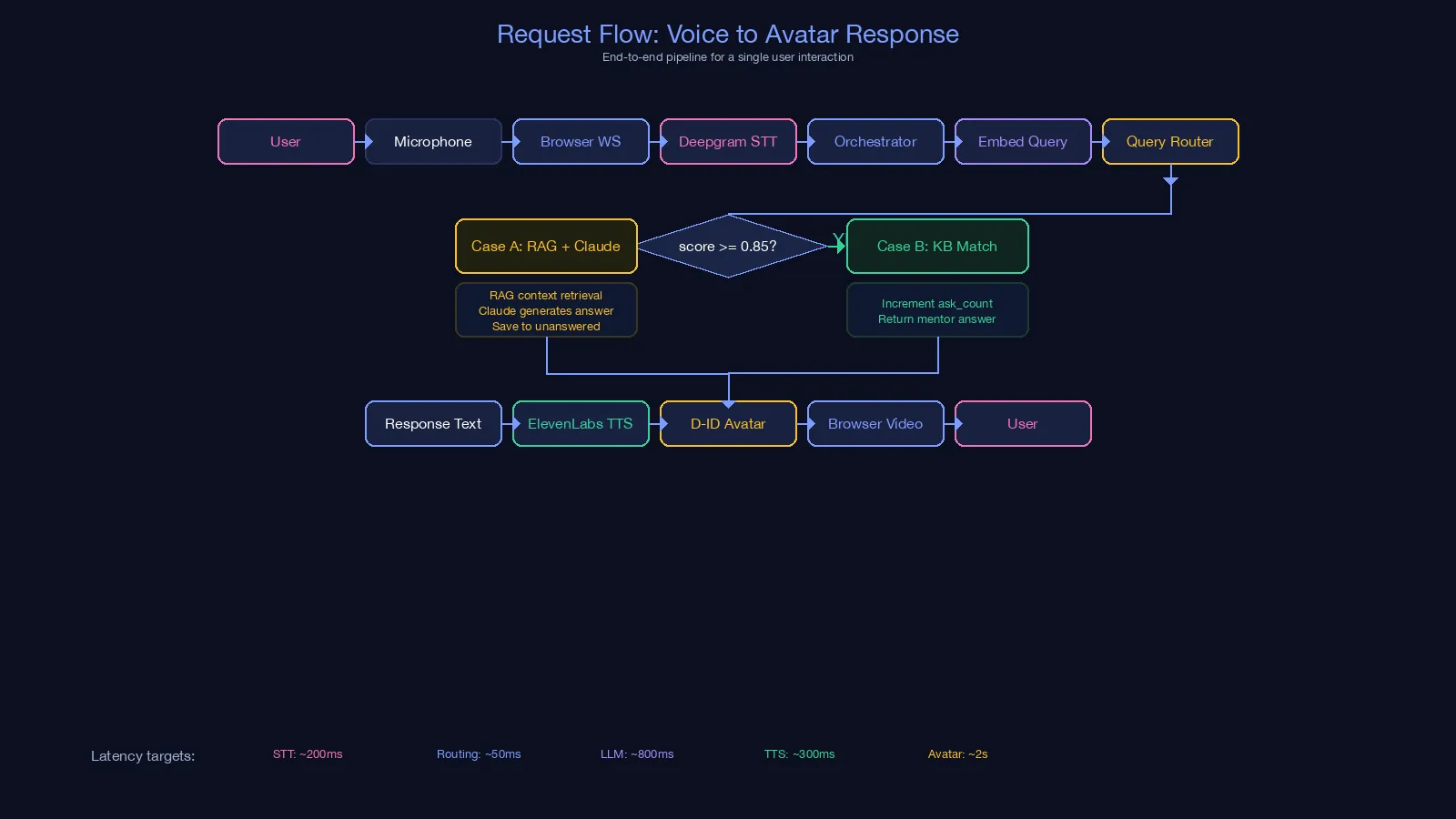
This flow shows the runtime sequence for one user interaction:
- User audio enters through microphone and browser WebSocket.
- STT converts speech to text and passes it to the orchestrator.
- Query embedding + router decide between Case A and Case B.
- Output text goes through TTS and then avatar video rendering.
- Final response is delivered back to the browser as synchronized audio/video.
The latency notes in the diagram clarify where response time is spent across STT, routing, generation, TTS, and avatar rendering.
3) Two-Mode Answering: Query Routing Logic
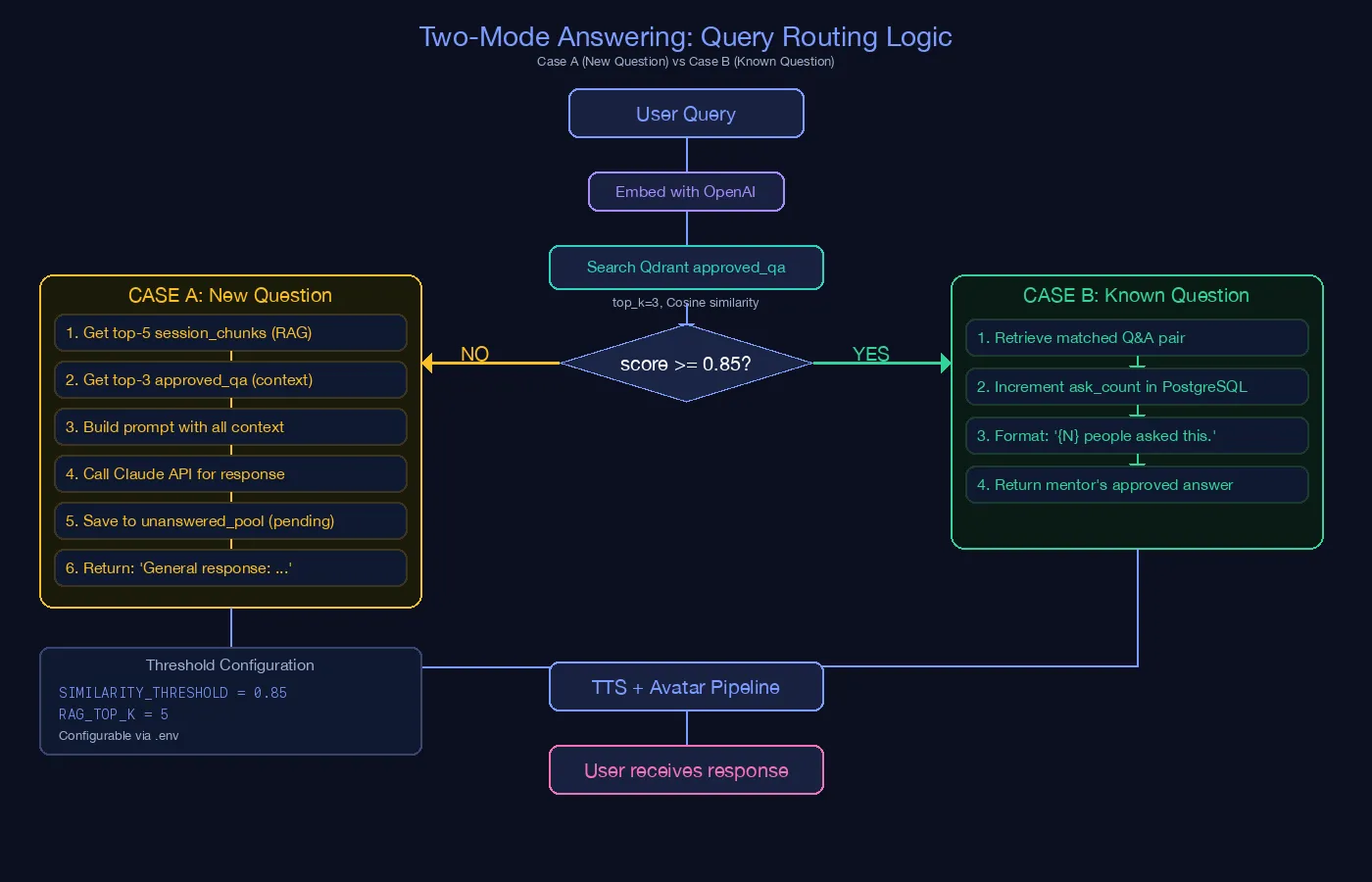
This diagram explains the retrieval threshold strategy:
- User query is embedded and searched against
approved_qain Qdrant. - If similarity score is above threshold (
>= 0.85), the system runs Case B, returns mentor-approved knowledge, and incrementsask_count. - If below threshold, it runs Case A, pulls
session_chunks+ approved context, calls Claude, and stores unresolved items inunanswered_pool.
It documents why the system can stay reliable for known questions while still handling new questions dynamically.
4) Knowledge Quality Loop
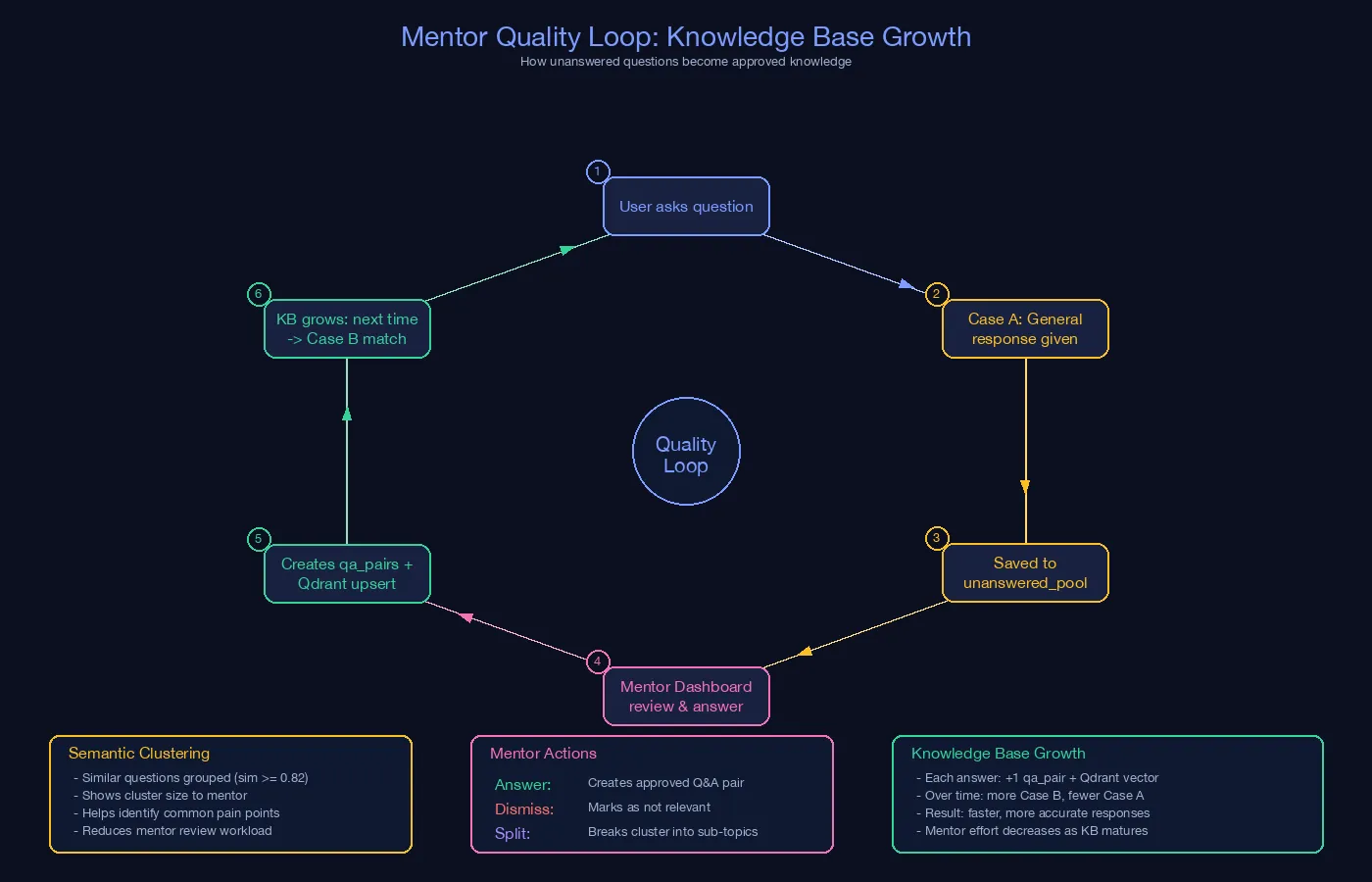
This loop shows how unanswered questions become reusable knowledge:
- New/low-confidence queries are saved to
unanswered_pool. - Similar unanswered questions are semantically clustered for mentor review.
- Mentor dashboard is used for answer, dismiss, bulk answer, or split-variant actions.
- Approved answers are inserted into
qa_pairsand upserted to Qdrant. - Future similar queries increasingly hit Case B, reducing ambiguity and response variance over time.
It captures the continuous improvement mechanism of the platform’s knowledge base.
5) User Memory Feature: Extraction and Recall
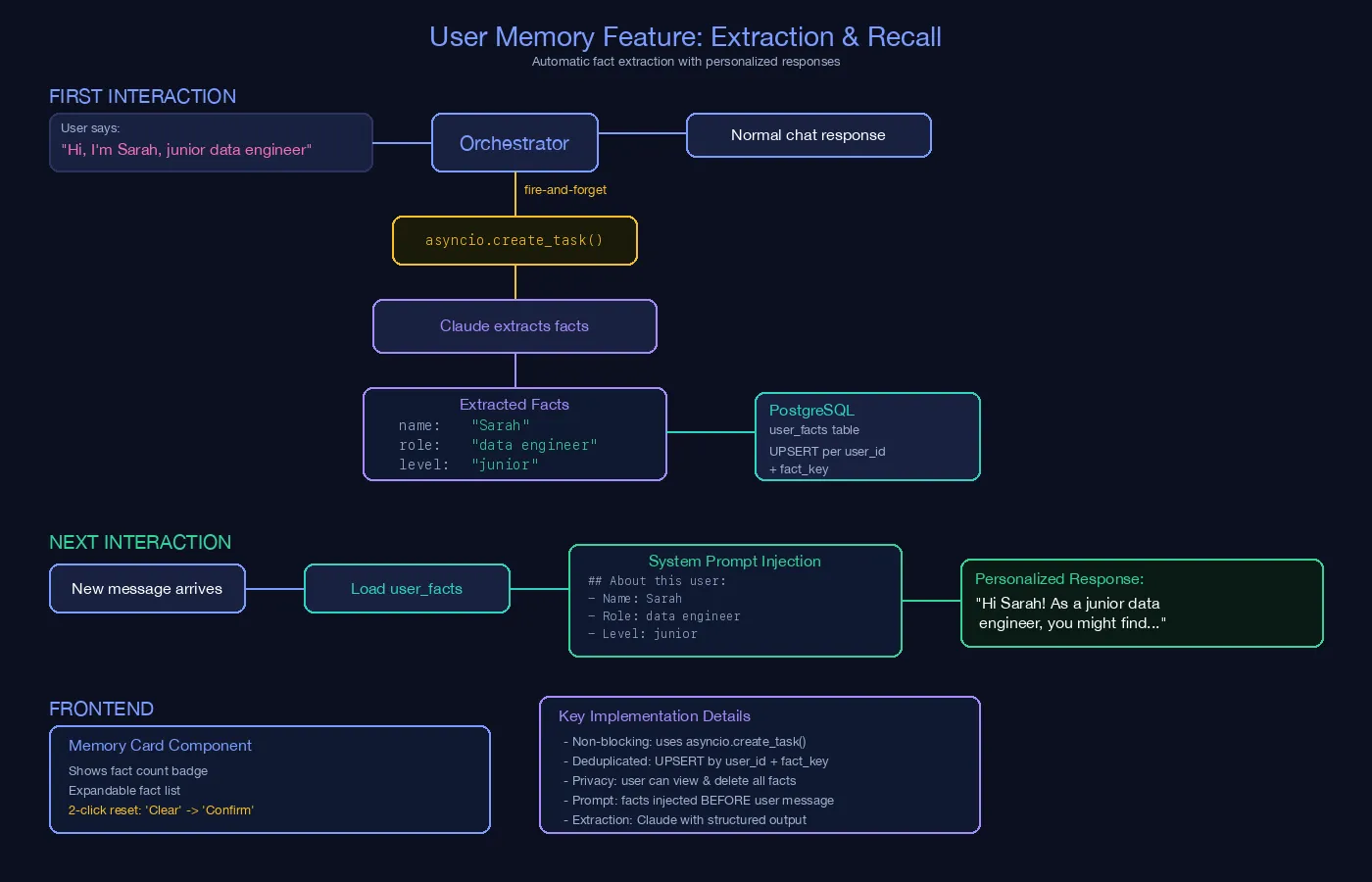
This diagram describes personalized memory behavior:
- During interaction, facts are extracted asynchronously (non-blocking path) while normal response continues.
- Structured facts are persisted in
user_factswith upsert logic. - On later interactions, user facts are loaded and injected into the system prompt before generation.
- Frontend memory card supports user visibility and safe reset actions.
It explains how personalization is implemented without adding blocking latency to the main conversation path.
Core Backend Responsibilities
- Session and conversation orchestration
- Similarity-based route selection
- Retrieval-augmented generation assembly
- User memory extraction and recall
- Provider abstraction for STT, LLM, TTS, and avatar systems
- Reviewer endpoints for unanswered-question lifecycle
- Transcript ingestion, chunking, embedding, and RAG index maintenance
- Quick-test and threshold-tuning flows for retrieval behavior
- Qdrant source/chunk deletion flows for RAG index cleanup
- Persistent
session_transcripts,conversations, anduser_factsstorage
Key Outcomes
- Delivered a production-style architecture for low-latency conversational avatar interactions.
- Built a scalable two-path routing strategy for known vs novel queries.
- Added long-term user memory for personalization across sessions.
- Implemented a continuous reviewer feedback loop to improve answer quality over time.
- Added a mentor dashboard for ingesting content, reviewing unresolved questions, testing the pipeline, and tuning retrieval thresholds.
- Added bilingual Persian RTL and English LTR handling for the product interface.
- Added file-upload based transcript ingestion and RAG source management for university-style demo scenarios.
Skills
- AI Systems Design
- Real-Time Orchestration
- Retrieval-Augmented Generation (RAG)
- Backend API Engineering
- Vector Search Integration
- Conversation Memory Design
- Automation Workflow Design
- Python